Overview
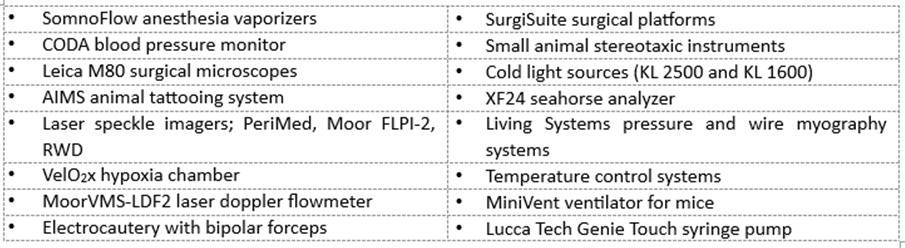
The overall objective of the Rodent Experimental Stroke & Surgical core (RESS) is to provide the instrumentation, expertise, resources and training for the incorporation of animal models of stroke into the research of project leaders in the Stroke CoBRE and researchers in the greater WVU neuroscience and cardiovascular research communities. The RESS core has developed multiple experimental rodent stroke models and collaborated with researchers using animal models. Current available animal models include: photothrombotic stroke (PTS), transient, permanent, and distal middle cerebral artery occlusion (MCAO), cerebral hypoperfusion, hypoxia, subarachnoid hemorrhage, stereotaxic application of endothelin-1, cardiac arrest/ cardiopulmonary resuscitation (CA/CPR) global ischemia, carotid ligation, and traumatic brain injury. The RESS core also develops new surgical animal models as requested by investigators. The RESS core houses equipment for conducting animal surgeries, including active anesthesia scavenging systems, Leica surgical microscope (M80), laser speckle imagers, laser doppler flow (MoorVMS-LDF2), CODA monitor fully automated controller with LCD display (blood pressure monitor), animal tattooing system, hypoxia ischemia chamber, blood gas analyzer, precision small animal electro-cautery with bipolar forceps, homoeothermic blanket and temperature control systems, small animal stereotaxic instruments, and two cold light sources (KL 2500 and KL 1600, Schott, Germany), mouse ventilator, syringe pump, as well as pressure and wire myography systems.
Equipment
Contacts
Director
Kate Weil, PhD | ekaterina.weil@hsc.wvu.edu | (304) 293-1485
Acknowledgements
Please remember to acknowledge the grants that support the Experimental Stroke Core in all your publications:
Experimental stroke modeling was performed at the WVU Experimental Stroke Core supported by NIH
grant P20GM109098.